What Are These Tiny Glass Tubes Found Under a Bathroom Cabinet? Their Possible Uses Explained
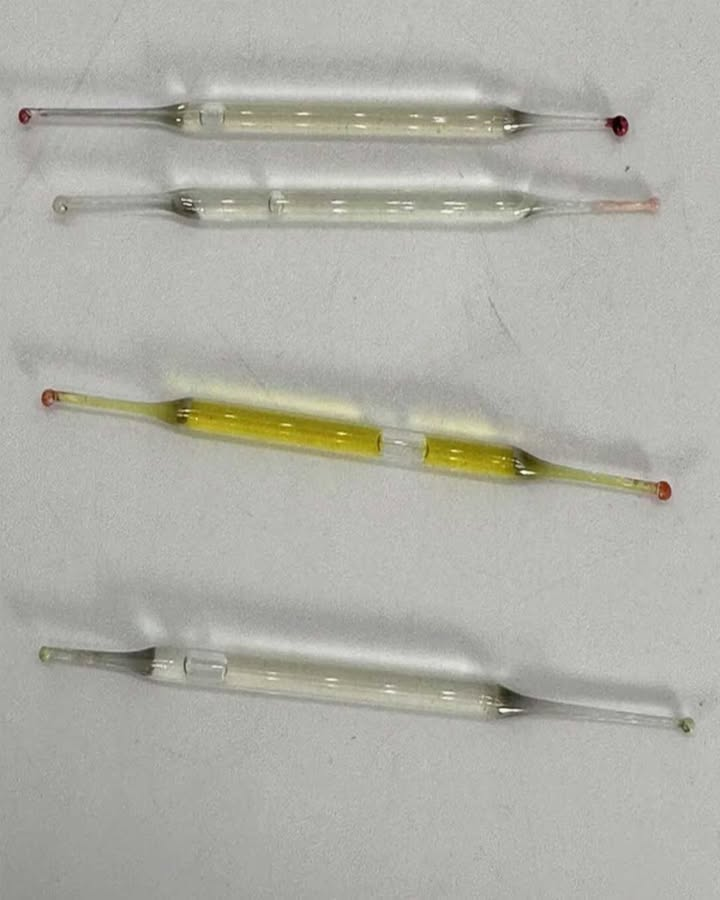
Discovering something unusual during a home renovation can turn an ordinary project into a fascinating mystery. While removing an old bathroom cabinet, you might expect to find dust, forgotten toiletries, loose screws, or perhaps an old bottle of cleaning product. But what if you discover several tiny glass tubes, each approximately five centimeters long, sealed at both ends and apparently filled with liquid?
At first glance, these strange objects might look like miniature laboratory containers. Their unusual elongated shape, narrow ends, and transparent bodies make them difficult to identify without additional information.
The objects shown in the photograph resemble small sealed glass ampoules. These containers have been used for different purposes, including storing medicines, cosmetic preparations, fragrances, and chemical samples. Some specialized double-ended glass ampoules are also used as components inside other products.
Although their appearance provides useful clues, it is impossible to determine exactly what they contain simply by looking at them.
Their discovery raises several interesting questions: Why were they stored in a bathroom? What were they originally used for? Are they valuable collectibles? And, most importantly, is it safe to handle them?
Let’s explore the possibilities.
1. What Are Glass Ampoules?
An ampoule is a small container, usually made from glass, designed to hold a specific quantity of liquid or another substance.
Traditional pharmaceutical ampoules are commonly sealed by heating the glass until it melts and closes around the contents. This creates an airtight container that protects the substance from outside contamination and exposure to air.
Unlike ordinary bottles, sealed ampoules are generally intended for controlled, single-use applications.
They come in different shapes and sizes. Some have a rounded body with a narrow neck that can be broken open, while others have unusual elongated designs with narrow ends.
The objects in the photograph appear to have a double-ended structure, which makes them different from many familiar modern medicine ampoules.
Their shape suggests that they were manufactured for a particular purpose rather than being ordinary miniature bottles.
However, several products can use similar glass components, so appearance alone is not enough to establish their identity.
2. Could They Be Old Perfume Ampoules?
One possible explanation is that the objects were once used to store small quantities of fragrance.
Perfume samples have been packaged in many different ways throughout the history of the cosmetics industry. Small glass containers were particularly useful because glass can provide a barrier against many substances that might otherwise interact with the fragrance.
Small fragrance samples allowed people to test perfumes without purchasing a full-sized bottle.
Some were included in beauty gift sets, while others were distributed through shops, promotional campaigns, and personal-care products.
The transparent glass shown in the photograph could be consistent with a fragrance-related container, especially if the liquid has a slight yellow or amber color.
Nevertheless, this is only a possibility.
The presence of liquid inside a glass tube does not prove that it contains perfume. Many unrelated products use transparent glass packaging, and old liquids can change color during storage.
A fragrance product would often have some additional identifying information, such as a label, packaging, brand name, or recognizable scent. Without those clues, it is impossible to confirm this explanation.
Important: Never break an unidentified ampoule simply to smell its contents. An old fragrance sample may contain irritating ingredients, and the broken glass itself can cause injuries.
3. Could They Be Cosmetic or Beauty Treatment Ampoules?
Another possibility is that the tubes were associated with cosmetic or personal-care products.
Small ampoules have been used in beauty treatments to package concentrated preparations intended for particular applications.
Examples of products that may be packaged in small sealed containers include:
Hair and scalp treatments.
Skin-care preparations.
Cosmetic serums.
Concentrated conditioning products.
Professional beauty treatment solutions.
Specialized personal-care formulations.
Some cosmetic products are sold in single-use quantities to help preserve their contents and reduce repeated exposure to air.
This packaging can be particularly useful when a formula contains ingredients that may deteriorate after opening.
Bathroom cabinets are common places to store beauty and personal-care products, making this explanation plausible based on where the objects were discovered.
However, the photograph does not provide enough evidence to identify them specifically as cosmetic ampoules.
The liquid’s color, thickness, and appearance cannot reliably establish its chemical composition.
Even if the objects originally contained a beauty product, they should not be opened or applied to the skin when their identity and age are unknown.