Can Two Tablespoons of This White Mineral Really Make Bone Pain, Nerve Problems, Anxiety, Depression and Insomnia Disappear?
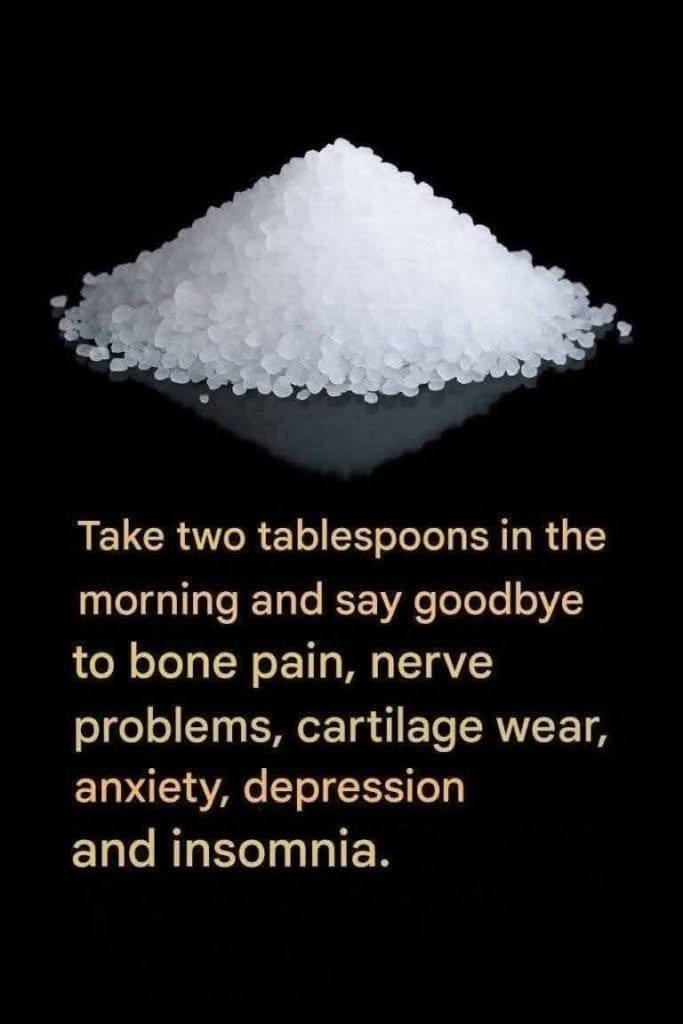
A viral image showing a pile of white crystals makes a very bold promise:
“Take two tablespoons in the morning and say goodbye to bone pain, nerve problems, cartilage wear, anxiety, depression and insomnia.”
That claim needs a major reality check.
The image appears to show a salt-like mineral, but the photograph alone does not establish exactly what substance it is. Similar-looking white crystals can include table salt, sea salt, Epsom salt (magnesium sulfate), or other products.
And that distinction is extremely important because taking two tablespoons of an unidentified mineral every morning is not a safe health recommendation.
There is a real connection between minerals such as magnesium and normal nerve, muscle, and bone function—but that does not mean a large spoonful of a white powder can cure multiple diseases.
The First Rule: Don’t Swallow an Unknown Powder
This is the most important point.
A photograph cannot tell you whether the crystals are:
Sodium chloride
Magnesium sulfate
Another magnesium compound
A supplement
A chemical intended for external use
Something else entirely
Never consume a substance simply because it looks like something edible in a social-media photograph.
The label and ingredient list matter.
If the Image Is Referring to Epsom Salt
One possible interpretation of the viral post is Epsom salt, which is magnesium sulfate.
Magnesium itself is an essential mineral. It participates in hundreds of biochemical processes and contributes to normal nerve and muscle function, energy production, and bone structure. (
But magnesium sulfate isn’t interchangeable with every other magnesium supplement.
The NIH notes that different magnesium compounds have different absorption characteristics, and magnesium sulfate is generally less bioavailable than forms such as magnesium citrate, chloride, lactate, and aspartate.
So the phrase “two tablespoons of this every morning” should not be treated as a standard magnesium recommendation.
Magnesium Really Is Important for Bones
This is one part of the viral claim that contains a kernel of truth.
Magnesium contributes to the structural development of bone and is involved in processes regulating calcium and vitamin D.
People need adequate magnesium throughout life.
Good dietary sources include:
Nuts
Seeds
Beans
Lentils
Whole grains
Leafy green vegetables
Some dairy products
Fortified foods
The NIH recommends roughly 310–320 mg per day for adult women and 400–420 mg for adult men, depending on age and other circumstances.
But there’s a huge difference between:
getting enough magnesium
and
taking a large dose of a magnesium-containing powder.
More Magnesium Doesn’t Automatically Mean Stronger Bones
It’s tempting to think:
Magnesium is important for bones → more magnesium must make bones stronger.
The body doesn’t work that way.
The NIH notes that higher magnesium intake is associated with bone mineral density in some studies, but more research is needed to determine whether magnesium supplements actually prevent or treat osteoporosis.
So magnesium is an important nutrient, but it isn’t a standalone treatment for bone pain or cartilage deterioration.
What About Cartilage Wear?
“Cartilage wear” can refer to problems such as osteoarthritis.
Osteoarthritis involves changes to joints and surrounding tissues. It isn’t simply a magnesium deficiency.
Taking a mineral powder cannot be expected to rebuild worn cartilage.