The “Most Powerful Herb” for Parasites, Infections and Viruses? What Thyme Can—and Cannot—Really Do
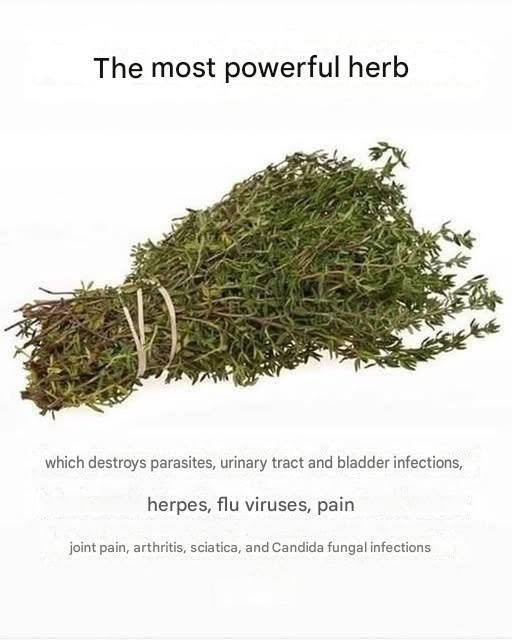
The herb shown in the image is thyme, most commonly referring to Thymus vulgaris. Thyme has been used for centuries in cooking and traditional herbal practices, and modern research has investigated compounds found in thyme, particularly thymol and carvacrol.
But there is an important distinction between a plant showing antimicrobial activity in laboratory experiments and proving that eating or drinking the plant can cure an infection in a person.
The viral claim that thyme “destroys parasites, urinary tract and bladder infections, herpes and flu viruses” is much stronger than the evidence currently supports. Some laboratory studies have found interesting antibacterial or antimicrobial effects from thyme extracts or essential oils, but that does not mean thyme is a proven treatment for all of these conditions.
That doesn’t make thyme uninteresting. In fact, it is a fascinating herb with several compounds that researchers continue to study.
Let’s separate the traditional uses, laboratory evidence and what is actually known about using thyme safely.
What Is Thyme?
Thyme is a small aromatic herb belonging to the mint family. The species commonly used in cooking is Thymus vulgaris.
It is widely used to flavor:
Meat
Vegetables
Soups
Stews
Sauces
Beans
Fish
Herbal teas
The plant contains numerous naturally occurring compounds. Two that receive considerable attention in scientific research are thymol and carvacrol.
These compounds have demonstrated antimicrobial activity in laboratory studies, which is one reason scientists have investigated thyme and thyme essential oil for potential applications against bacteria and other microorganisms.
For example, laboratory research has found that thyme preparations can inhibit the growth of certain bacteria under experimental conditions.
However, laboratory activity is only the beginning of the research process.
A substance that kills bacteria in a laboratory dish does not automatically become a safe or effective medicine when consumed by humans.
Can Thyme Destroy Parasites?
This is one of the claims frequently made about thyme online.
There is some experimental research investigating compounds from aromatic herbs against different microorganisms and parasites. However, the statement that ordinary thyme consumption will “destroy parasites” in the human body is not supported as a general medical claim.
Parasitic infections are not all the same.
Different parasites require different diagnostic tests and treatments. Some affect the digestive system, while others can affect the blood, liver, lungs, nervous system or other organs.
The appropriate treatment depends on the specific parasite.
This is why someone who suspects a parasitic infection shouldn’t simply rely on thyme tea or an herbal preparation without knowing what is actually causing the symptoms.
If a parasite is confirmed, a healthcare professional can determine whether a specific antiparasitic medication is necessary.
Why do people associate thyme with parasites?
The explanation often comes from laboratory research.
Scientists have studied essential oils and plant compounds because some demonstrate antimicrobial effects under controlled experimental conditions.
That research is scientifically interesting, but it shouldn’t be converted into the claim that “thyme kills all parasites.”
Those are two very different statements.
Can Thyme Treat a Urinary Tract Infection?
This is another area where the evidence needs to be interpreted carefully.
Some laboratory studies have found that thyme oil or thymol can affect bacteria associated with urinary tract infections.
For example, researchers studying uropathogenic E. coli found that thymol-rich thyme oil could inhibit bacterial biofilm formation and affect bacterial virulence factors in laboratory experiments.
Another study tested essential oils against several bacteria associated with urinary tract infections and found antibacterial activity from thyme essential oil under experimental conditions.
These findings are interesting.
But they do not establish that drinking thyme tea can cure a urinary tract infection.
That’s an important distinction.
A UTI can involve bacteria that may require appropriate antibiotic treatment. Untreated infections can sometimes spread to the kidneys and cause more serious illness.
A review of complementary approaches to urinary tract infections noted that UTIs often require conventional medical treatment and that herbal approaches need to be evaluated based on the quality of available evidence.