These Are the Consequences of Ignoring Severe Knee Pain: What This Image Really Shows
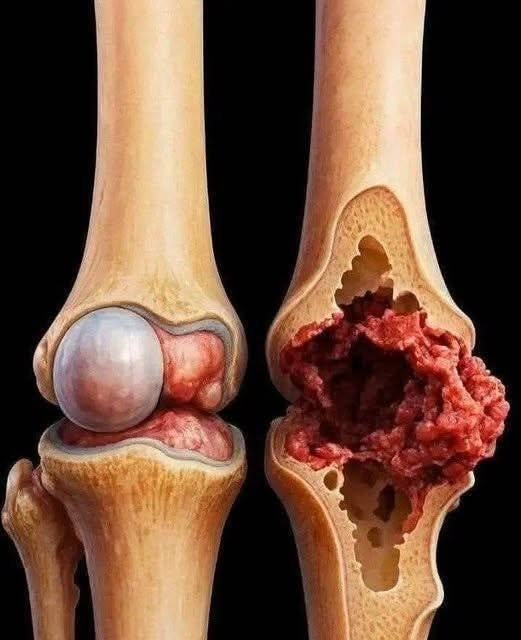
The image above is designed to look shocking. It compares a relatively normal-looking knee joint with a severely damaged knee in which the surrounding bone and joint structures appear dramatically abnormal.
The caption says, “ATTENTION: These Are the Consequences of Sleeping With…”, but the image itself does not provide enough information to establish that sleeping in a particular position, sleeping with a particular object, or following a particular nighttime habit causes the condition shown.
What the image does illustrate is something much more important: serious damage to the knee joint and surrounding bone can occur for a number of different medical reasons, and persistent knee symptoms should not simply be ignored.
The right side of the illustration appears to show extensive destructive changes around the knee. Such an appearance can be associated with advanced joint disease, severe bone destruction, infection, inflammatory disease, or other serious conditions. A medical illustration also cannot be used to diagnose a real person.
Understanding what can damage the knee—and knowing when pain requires medical attention—is much more useful than believing a dramatic social-media claim.
What Does a Healthy Knee Look Like?
The knee is one of the largest and most complicated joints in the human body.
It connects the thigh bone, called the femur, with the shin bone, called the tibia. The kneecap, or patella, also forms part of the joint.
A healthy knee contains several important structures that work together.
These include:
Bones
Articular cartilage
Menisci
Ligaments
Tendons
Muscles
Synovial tissue
Joint fluid
The surfaces where the bones meet are covered by smooth cartilage.
This cartilage allows the bones to move against each other with very little friction.
The knee also contains a small amount of lubricating joint fluid that helps movement.
When these structures are healthy, the knee can bend, straighten, rotate slightly, and support the body’s weight during walking, climbing stairs, and other activities.
What Happens When Knee Cartilage Becomes Damaged?
One of the most common causes of chronic knee pain is osteoarthritis.
Osteoarthritis occurs when the tissues within the joint undergo structural changes over time.
The cartilage can become thinner and less smooth.
As the condition progresses, the joint may become painful and stiff.
In advanced cases, the space between the bones can become considerably reduced because the protective cartilage has been lost.
The bones can also develop changes such as osteophytes, commonly called bone spurs.
However, osteoarthritis is only one possible explanation for serious knee abnormalities.
That is why an alarming image should never be used as a diagnosis.
Why Can Knee Osteoarthritis Develop?
There isn’t always one single cause.
Several factors can increase the likelihood of developing osteoarthritis.
Age
The risk generally increases as people get older.
This does not mean that knee pain is an unavoidable part of aging, but changes in the joint become more common over time.
Previous Injury
A significant knee injury can increase the risk of developing arthritis later.
Examples include certain ligament injuries, meniscus injuries, and fractures involving the joint.
Repetitive Joint Stress
Some occupations and activities place repeated stress on the knees.
Frequent kneeling, squatting, lifting, or high-impact activity may contribute to joint problems in some people.
Body Weight
Higher body weight can increase the mechanical load placed on weight-bearing joints such as the knees.
It can also be associated with metabolic and inflammatory factors that may influence joint health.
Genetics
Family history can also influence the likelihood of developing osteoarthritis.
Some people are more genetically predisposed to certain joint problems than others.
Does Sleeping in the Wrong Position Destroy the Knee?
This is where viral health posts often become misleading.
Sleeping position can sometimes influence comfort, especially if someone already has joint pain.
For example, certain positions may place pressure on an uncomfortable knee or cause one leg to remain in an awkward position for an extended period.
But that is very different from saying that a particular sleeping position causes severe bone destruction.
There is no simple rule that says sleeping on one side, sleeping with your knees bent, or sleeping with a pillow between your legs will cause the kind of dramatic structural destruction shown in the illustration.
If a person wakes with knee pain after sleeping, the pain may be related to an existing joint problem, pressure on the joint, muscle tension, or positioning.
Changing sleeping position may improve comfort, but it does not reverse established joint damage.
Why Does the Knee Become Stiff After Sleeping?
Many people with joint problems notice stiffness when they first get out of bed.
This can happen because the knee has remained relatively inactive for several hours.
People with osteoarthritis may experience stiffness after periods of inactivity, including sleeping or sitting for a long time.
The stiffness may improve after moving around for several minutes.
However, prolonged morning stiffness can also occur with inflammatory forms of arthritis.
The duration and pattern of stiffness therefore matter.
If morning stiffness is severe, persistent, or accompanied by swelling or other symptoms, medical evaluation may be appropriate.
Not All Knee Pain Is Arthritis
This is extremely important.
Knee pain can have many causes.
Possible causes include:
Osteoarthritis
Rheumatoid arthritis
Gout
Bursitis
Tendinitis
Meniscus injuries
Ligament injuries
Muscle strains
Fractures
Infections
Inflammatory joint diseases
Nerve-related problems
Certain bone conditions
The treatment depends on the cause.
Taking pain medication without determining the underlying problem may temporarily reduce discomfort without addressing the reason the knee hurts.