Why Are Some Electrical Outlets Installed Upside Down? The Real Reason Explained
This is where viral posts often become misleading.
There is not a universal rule saying that every ordinary wall receptacle must have the ground opening facing upward.
Electrical codes can vary by country, jurisdiction, building type, and installation.
Even within systems based on the U.S. National Electrical Code, receptacle orientation is not simply a universal “ground must be up” rule for ordinary wall outlets.
The important electrical-code requirements concern proper grounding, installation, protection, and location.
So if you see one outlet installed ground-up and another ground-down, that does not automatically mean one of them violates electrical code.
Why Do Some Buildings Have Every Outlet Ground-Up?
You may see a building where every receptacle has the grounding opening at the top.
This can be the result of a consistent installation preference.
An electrician, contractor, institution, or facility may choose one orientation and use it throughout a building.
Consistency has practical advantages.
If every outlet is installed the same way, electricians and maintenance workers know what to expect.
You may therefore see ground-up receptacles throughout certain commercial, industrial, healthcare, or institutional environments.
That doesn’t mean the orientation itself is a secret code.
It may simply be the installation standard chosen for that building.
What About Hospitals?
Hospitals and other healthcare facilities can have very specific electrical requirements.
They may use special hospital-grade receptacles and additional grounding and electrical safety measures.
However, it would be incorrect to assume that “ground-up means hospital” or that every ground-up outlet is a hospital-style installation.
The orientation alone cannot tell you what kind of building you’re looking at.
A normal household receptacle can also be installed ground-up.
Does an Upside-Down Outlet Mean It Is Controlled by a Switch?
Not necessarily.
Another popular claim says that an upside-down receptacle means the outlet is controlled by a wall switch.
That is not a universal rule.
Some electrical installations may use different orientations to distinguish circuits or switched receptacles, but orientation alone is not a reliable way to determine whether an outlet is switched.
If you want to know whether a receptacle is controlled by a wall switch, the practical way is to test it or examine the electrical installation.
Some modern receptacles also have markings that indicate special functions.
What About Split Receptacles?
Some receptacles can have their two outlets controlled separately.
For example, one half might be permanently powered while another half is controlled by a wall switch.
This arrangement has historically been used in places where a switched lamp is desired.
But again, the physical orientation of the receptacle is not enough to tell you whether it is a split or switched receptacle.
The wiring configuration behind the device is what determines that.
Why Are the Two Outlets in the Photograph Different?
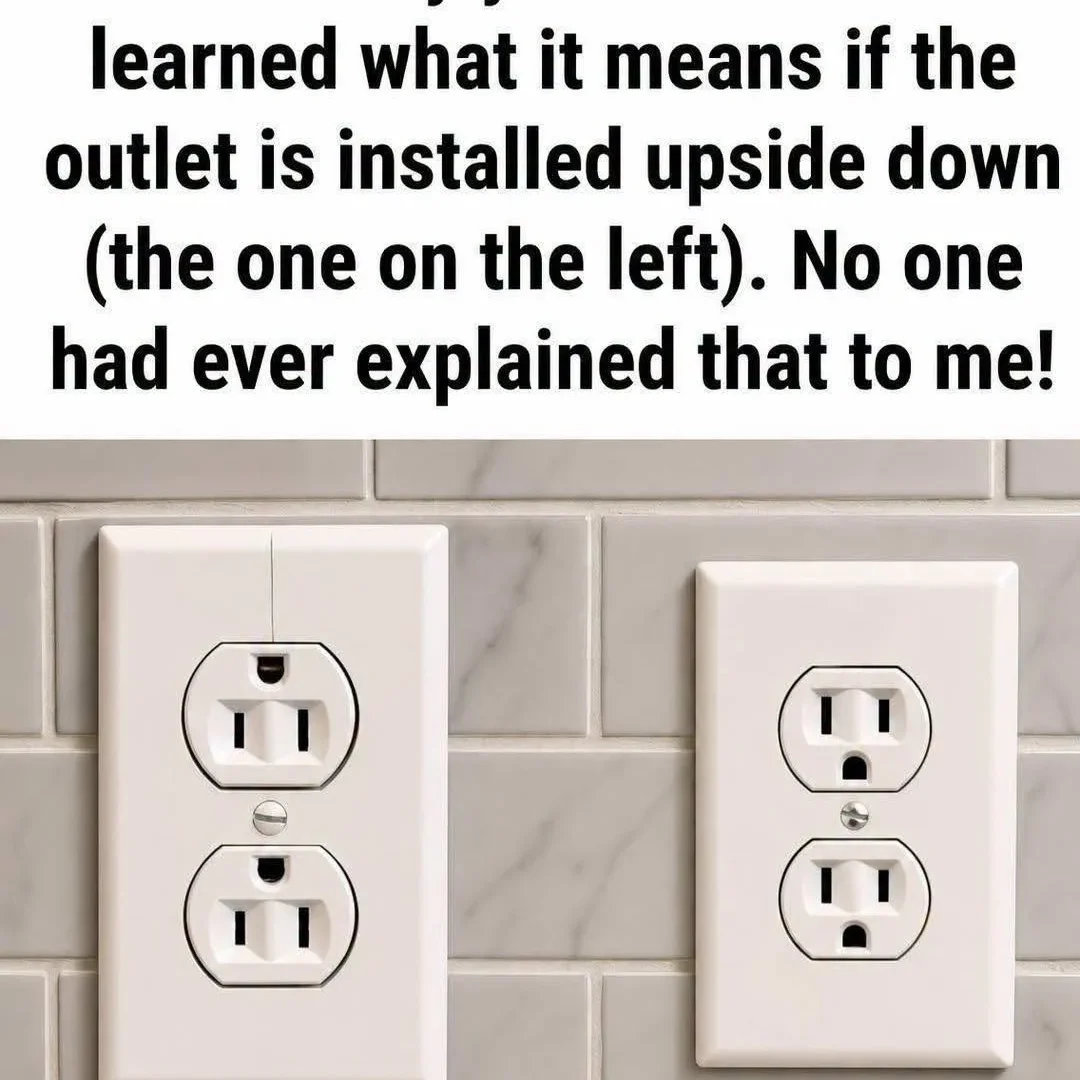
The image shows two duplex receptacles installed in different orientations.
The left one has the grounding opening at the top.
The right one has the grounding opening at the bottom.
Both orientations can be physically functional.
The difference does not automatically mean that the two outlets have different electrical voltages, different electricity costs, or different levels of power.
The outlet’s orientation isn’t a secret indicator of how much electricity it provides.
Does Ground-Up Save Electricity?
No.
Changing the orientation of a receptacle does not make your electrical appliances consume less electricity.
A refrigerator, television, computer, heater, or charger will not use less energy simply because the ground pin is above the two slots.
Electricity consumption is determined by the appliance, its operating conditions, and the electrical system—not by whether the wall receptacle is mounted with the ground opening up or down.
Does It Mean the Outlet Is Safer?
Not automatically.
The grounding system is what provides an important path for fault current.
If an electrical fault causes current to reach exposed metal, a properly grounded system and appropriate circuit protection can help reduce the danger.
The orientation of the receptacle is only one physical detail.
A ground-up receptacle that is improperly wired is still a serious electrical problem.
A correctly wired ground-down receptacle can be perfectly safe.
The Most Important Part Is Proper Wiring
If you’re concerned about an outlet, don’t focus primarily on its orientation.
More important questions are:
Is it properly grounded?
Are the wires securely connected?
Is the receptacle correctly rated?
Is the circuit appropriately protected?
Is there evidence of overheating or damage?
Does the outlet have GFCI protection where required?
These factors have much greater significance for electrical safety.