We Ordered a Salad, but There Were Tiny Black Specks in the Food — Why We Went Straight to the Hospital
If you find an unusual seed in food, avoid these common mistakes:
Don’t eat it to “test” it.
Taste is not a reliable way to determine toxicity.
Don’t give it to another person.
Especially not a child or pet.
Don’t grind it into powder.
Breaking or crushing some seeds can change exposure characteristics.
Don’t make homemade remedies from it.
An unknown plant should never be turned into tea, powder, oil, or another preparation.
Don’t assume “natural” means safe.
Some of the most potent toxins in nature come from plants.
Don’t rely on a viral comment.
A comment saying “I know exactly what this is” is not the same thing as professional identification.
What If There Are No Symptoms?
The absence of symptoms immediately after eating something suspicious does not necessarily prove that there is no risk.
Different substances act at different speeds.
Some exposures cause immediate irritation.
Others may take longer.
Some may produce relatively mild symptoms, while others can cause serious illness.
Therefore, if there is a genuine possibility that a poisonous substance was swallowed, don’t use “I feel fine right now” as the only reason to dismiss the exposure.
Seek appropriate advice based on the substance and circumstances.
Why Going to the Hospital Can Be Reasonable
The title of the image says the people “went straight to the hospital.”
Whether hospital evaluation is necessary depends on the circumstances.
If someone knowingly or potentially swallowed an unidentified substance that could be toxic, medical evaluation may be appropriate.
It is especially important if:
A child was exposed.
A large amount may have been eaten.
The material could be a known poisonous plant.
The person is already experiencing symptoms.
The substance cannot be identified.
The person has a significant underlying medical condition.
Medical professionals can determine whether observation, testing, treatment, or no further intervention is necessary.
Don’t Confuse Food Poisoning With Chemical Poisoning
Food poisoning is often associated with microorganisms such as bacteria or viruses.
An unknown seed or plant material represents a different type of potential exposure.
The symptoms can overlap, including nausea, vomiting, abdominal pain, and diarrhea, which is another reason it can be difficult to determine the cause based solely on symptoms.
Healthcare professionals consider the timing, food consumed, symptoms, exposure amount, and other information when evaluating a possible poisoning.
The Most Important Information to Record
If someone has accidentally eaten an unknown substance, try to remember:
What was eaten?
How much was eaten?
When was it eaten?
Was the object swallowed whole or chewed?
Who ate it?
How old is the person?
Are there any symptoms?
Is there a photograph or remaining sample?
This information can be extremely useful when speaking with medical professionals or poison specialists.
A Note About the Image
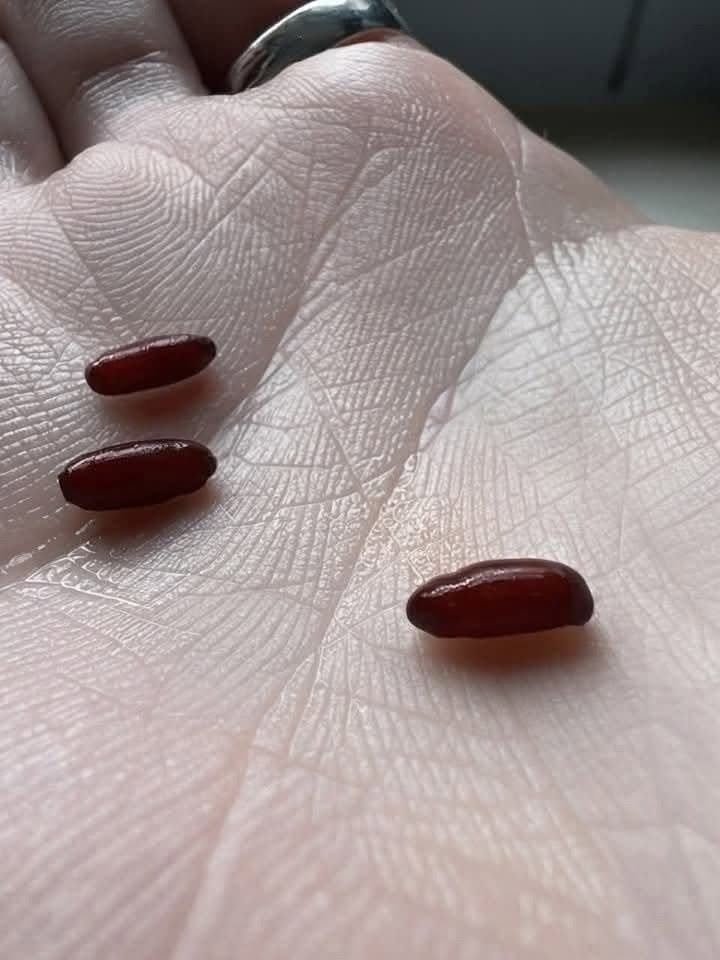
The small objects shown in the photograph are visually distinctive, but the photograph alone cannot establish their identity.
They appear seed-like, and some toxic seeds can have striking patterns or colors.
That is precisely why unidentified seeds should not be eaten.
If the image represents a real incident and someone actually swallowed the objects, the safest approach is to treat the situation as a possible ingestion of an unidentified substance rather than assuming the identity from the photograph.
If symptoms such as difficulty breathing, severe vomiting, confusion, seizures, fainting, or loss of consciousness occur, emergency medical care is warranted.
How to Prevent Similar Problems
There are several simple habits that can reduce the likelihood of consuming unwanted material in salads.
Wash fresh vegetables appropriately before eating.
Inspect leafy greens and vegetables before preparation.
Remove damaged or heavily contaminated leaves.
Keep raw produce away from chemicals and non-food materials.
Store vegetables properly.
When eating outside the home, report suspicious foreign objects to the restaurant rather than simply removing them and continuing to eat.
And perhaps most importantly, if something looks completely unfamiliar, don’t taste it to find out what it is.
Final Thoughts
Finding tiny black-and-white objects in a salad can certainly be alarming, particularly when they resemble unusual seeds.
However, it is important not to jump from a photograph to a definite diagnosis.
The objects could be harmless plant material, insect-related material, or something potentially toxic. Without reliable identification, nobody should claim with certainty what they are.
The safest response is straightforward:
Stop eating the food.
Do not taste the suspicious material.
Keep a sample and photograph it if possible.
Record what was eaten and when.
Contact an appropriate medical or poison-information service if ingestion may have occurred.
And if serious symptoms develop, seek emergency medical attention.
The most important lesson is not that every strange-looking seed is poisonous. It is that unknown substances should not be experimented with.
A salad should contain recognizable food ingredients. If something unexpected appears, taking a few minutes to investigate can be far safer than assuming it is harmless.
When it comes to unidentified objects in food, caution is not overreacting. It is simply good food-safety practice.