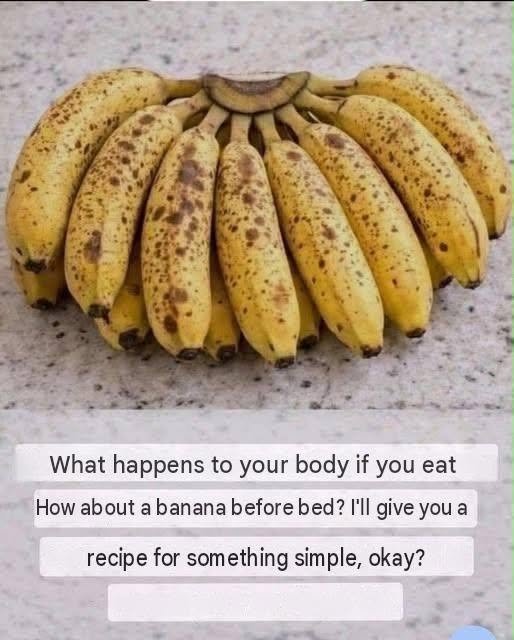
What Happens to Your Body If You Eat a Banana at Night?
Bananas are often featured in viral health posts claiming that eating one before bed can dramatically increase melatonin, improve sleep, relax the body, or even help you sleep through the entire night.
There is some interesting science behind the idea, but the social-media version is usually much stronger than the evidence.
Bananas contain nutrients and plant compounds that may be relevant to sleep, including tryptophan, vitamin B6, magnesium, potassium and naturally occurring melatonin-related compounds. Small human studies have also investigated bananas as a bedtime snack. However, eating one banana at night is not a proven treatment for insomnia, and there is no guarantee that it will noticeably increase your melatonin or improve your sleep.
So what actually happens when you eat one before bed?
Bananas Can Be a Nutritious Evening Snack
A banana provides carbohydrates, fiber, potassium, magnesium, vitamin B6 and other nutrients.
For example, USDA MyPlate data for a banana serving shows meaningful amounts of potassium and magnesium along with carbohydrate and fiber.
That makes a banana a convenient snack when you’re genuinely hungry in the evening.
Unlike many desserts and packaged snacks, a plain banana contains no added sugar.
It also requires virtually no preparation.
1. Could a Banana Increase Melatonin?
This is probably what the viral caption is hinting at.
There is some evidence that bananas can influence melatonin-related measurements, but the claim needs important context.
One human crossover study gave healthy volunteers two whole bananas and found that blood melatonin levels increased after consumption, with the highest measured concentration occurring around two hours afterward.
Another study involving 30 healthy volunteers found increased urinary levels of a melatonin metabolite after eating banana.
That’s interesting.
But these studies were relatively small, and they don’t establish that eating one banana immediately before bed will reliably make everyone sleep better.
A review of food and melatonin research also concluded that evidence concerning dietary sources is still limited and that additional studies are needed. (PubMed)
So it’s more accurate to say:
Bananas may influence melatonin-related processes, but they are not a proven natural sleeping pill.
2. Bananas Contain Tryptophan
Another reason bananas are sometimes associated with sleep is tryptophan.
Tryptophan is an essential amino acid that the body can use in pathways involved in producing serotonin and, ultimately, melatonin.
However, simply eating a food containing tryptophan doesn’t mean that all of it will be converted directly into melatonin.
The body’s metabolism is much more complicated than that.
Other nutrients, hormones, light exposure and the body’s internal circadian clock all influence melatonin production.
Research has found that dietary patterns containing tryptophan and appropriate daytime light exposure can influence nighttime melatonin secretion, but this does not prove that a banana alone has a powerful sleep-inducing effect.
3. Vitamin B6 Plays a Role in Neurotransmitter Production
Bananas also provide vitamin B6.
Vitamin B6 is involved in numerous metabolic processes, including the production of neurotransmitters.
Because serotonin is involved in the pathway leading to melatonin production, researchers have been interested in nutrients such as vitamin B6 when studying sleep.
But again, there’s an important distinction:
A nutrient being involved in a biological pathway doesn’t mean that eating extra amounts of the nutrient automatically produces more sleep.
If you’re already getting enough vitamin B6 from your diet, eating additional bananas isn’t necessarily going to produce a dramatic effect.